12 Nov 2025
Olympic Movement AI Engagement Forum 2025

We are proud to share that our first year PhD student, Dr Yosra Mekki, also a physician in sports medicine, was invited as faculty to speak at the International Olympic Committee’s Olympic Movement AI Engagement Forum, held on 12–13 November 2025 in Lausanne, Switzerland.
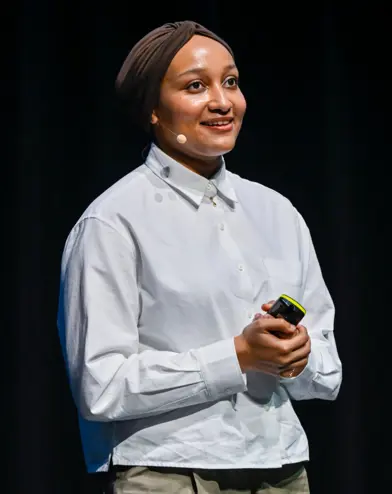
The Forum represents the IOC’s flagship conference dedicated to artificial intelligence and marked the first formal AI engagement of its kind at the level of the Olympic Movement. The inaugural Forum focused on the theme “Supporting athletes, clean competition and safe sport” and brought together stakeholders from across the Olympic ecosystem, including International Federations (IFs), National Olympic Committees (NOCs), Olympic Organising Committees (OCOGs), Worldwide Olympic Partners and media-rights holders. As the IOC’s principal platform for advancing its AI Agenda, the event convened senior leaders in medicine, science, technology and governance to shape how artificial intelligence will be responsibly implemented across global sport.
The invitation to contribute at this prestigious forum reflects the growing international recognition of research emerging from the Institute of Biomedical Engineering (IBME) at the University of Oxford, and from the Noble and Zavatsky Labs in particular, in advancing AI applications for athlete health.
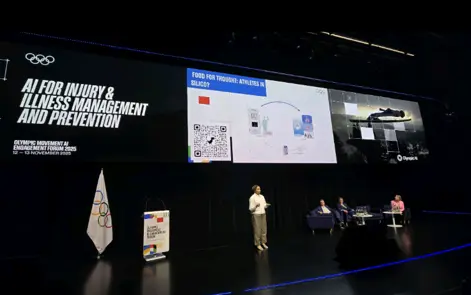
Dr Mekki’s doctoral research at IBME focuses on developing multimodal AI systems for elite athlete health, with a particular emphasis on female athletes and the need for more representative, data-driven approaches in sport. Her work explores how data streams can be integrated to support personalised injury prevention and management strategies for athlete health.
During a key session on AI for sports medicine, Dr Mekki addressed how AI systems can enhance elite athlete injury and illness management and prevention. She structured her talk around three common barriers organisations face when adopting AI: uncertainty about readiness, concerns about insufficient data, and the challenge of translating large volumes of data into meaningful clinical value. She emphasised that readiness is grounded not in technological sophistication, but in clearly defined clinical problems, high-quality data, multidisciplinary collaboration, and robust governance and ethical oversight.
Her presentation highlighted the importance of data quality in predictive modelling, reinforcing that reliable and equitable outcomes depend on well-structured and representative datasets. She also explored practical applications, including improving diagnostic pattern recognition, developing sport-specific predictive models for stress and injury risk, and streamlining risk management workflows through AI-enabled systems.
As part of the session, Dr Mekki introduced forward-looking concepts such as digital twins and synthetic datasets as innovative tools for safe experimentation and responsible advancement in elite sport settings. The digital twin framework presented builds on ideas previously featured in her interview with Nature Medicine (https://www.nature.com/articles/s41591-025-03938-7), where her work was highlighted in a discussion of emerging applications of digital twins in healthcare and sport.
The Forum featured contributions from IOC Members and Olympic medallists including Sarah Walker and Abhinav Bindra, alongside Dr Jane Thornton, IOC Director of Health, Medicine and Science; Ilario Corna, IOC Director of Information and Technology; and senior representatives from Worldwide Olympic Partners including Deloitte, Alibaba, Samsung, Allianz and Swiss Timing. The presence of leaders spanning governance, athlete representation, medicine and global technology partners underscored the high-level, cross-sector nature of the discussions.
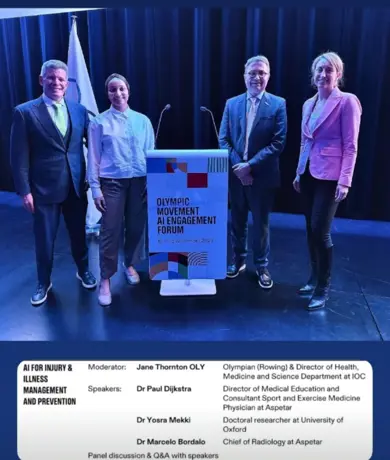
Dr Mekki’s session was moderated by Dr Jane Thornton, Director of Health, Medicine, and Science at the International Olympic Committee. Co-presenters included Dr Paul Dijkstra, Consultant Sport and Exercise Medicine Physician and Director of Medical Education at Aspetar Orthopaedic and Sports Medicine Hospital, and Dr Marcelo Bordalo, Head of Radiology at Aspetar.
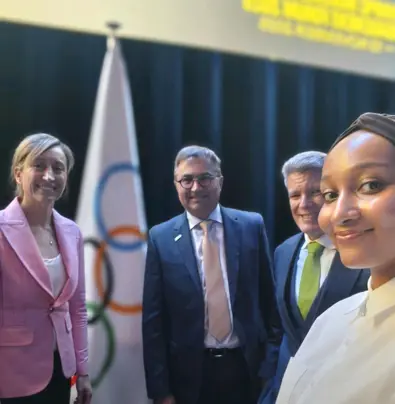
Reflecting on the experience, Dr Mekki said:
“It was an absolute privilege to be invited to contribute to the IOC’s first AI Engagement Forum at this level. Representing the Institute of Biomedical Engineering at Oxford, where I am a DPhil student within the Noble and Zavatsky Labs, was a true honour. I feel incredibly fortunate to be conducting this research within such an interdisciplinary environment. It was inspiring to engage with global leaders who are shaping how AI will support athletes, clean competition and safe sport in the years ahead.”


