07 Dec 2025
AI4DH at NeurIPS and EurIPS 2025

The Conference on Neural Information Processing Systems (NeurIPS 2025), held this year in San Diego, USA, and Mexico City, Mexico, is one of the world’s premier conferences in artificial intelligence and machine learning. Bringing together thousands of researchers from academia and industry, NeurIPS showcases the latest advances in machine learning, deep learning, and their applications across science, healthcare, and engineering. We are delighted to share that two papers from members of our group were presented at this year’s conference.
Moritz’s work, titled “DoseSurv: Predicting Personalized Survival Outcomes under Continuous-Valued Treatments,” was accepted to the main track of NeurIPS 2025. This work introduces a neural survival model that estimates the causal effect of dosage-dependent treatments on time-to-event outcomes, addressing a key challenge in personalised medicine. By integrating causal inference with survival analysis, DoseSurv enables more accurate and interpretable modelling of treatment effects over time. For more details, please refer to the paper.
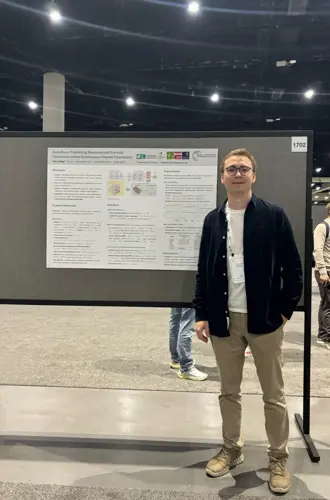
Katarina’s work, titled “GI-Clust: Deep Clustering for Early Gastrointestinal Cancer Detection,” was presented at the “Learning from Time-Series for Health” (TS4H) Workshop. This work addresses the challenge of early detection of gastrointestinal cancers, which are often asymptomatic and diagnosed late. In this work, Katarina developed GI-Clust, a deep clustering framework that learns patient patterns, identifies meaningful subgroups, and supports risk prediction using complex, sparse, and irregular primary care data. The study leverages QResearch, a large-scale longitudinal UK general practice dataset covering over 210,000 patients followed over five years, demonstrating the potential of data-driven phenotyping to improve early cancer risk identification. For more details, please refer to the paper.
Chenqi’s paper, titled “BioX-Bridge: Model Bridging for Unsupervised Cross-Modal Knowledge Transfer across Biosignals,” was selected to be presented at EurIPS 2025, held in Copenhagen. This work introduces an efficient framework for transferring knowledge between biosignal modalities by training a lightweight bridge network to align intermediate representations across foundation models. BioX-Bridge identifies optimal alignment points and employs a flexible prototype-based architecture, enabling unsupervised cross-modal learning without the computational overhead of traditional distillation methods. Across multiple modalities, tasks, and datasets, the approach reduces trainable parameters by 94–98% while maintaining or improving performance, demonstrating its potential to make multimodal biosignal analysis more accessible and scalable. For more details, please refer to the paper.
We congratulate Moritz, Katarina, and Chenqi on these outstanding achievements and their contributions to advancing machine learning for healthcare.


