Meltio M450 additive manufacturing system, department of Engineering Science, University of Oxford
WL-DED Metal Additive Manufacturing
Our Meltio M450 additive manufacturing system uses wire–laser directed energy deposition (WL-DED) to produce metallic parts and research specimens. It supports the development of processing conditions and tailored microstructures, enabling investigations of how manufacturing parameters influence defects, mechanical performance and hydrogen embrittlement.
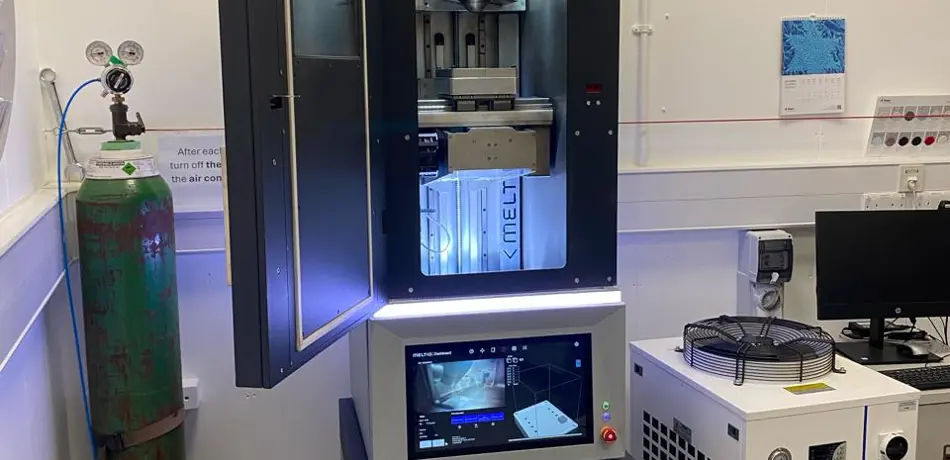
Capabilities:
Fabrication of small to medium-sized metallic parts and research specimens
Six 200 W direct diode lasers
Wire preheating to increase deposition rates
Processing of stainless steels, mild and carbon steels, titanium alloys and nickel-based alloys
Multi-metal deposition for research into dissimilar-material combinations
Optimisation of deposition parameters and shielding conditions
Assessment of resulting microstructures, defects and material performance using complementary facility testing
Sample dimensions: Parts can be printed within a build envelope of approximately 145 × 168 × 390 mm (width × depth × height). Achievable dimensions depend on material, geometry and deposition conditions.
Resources
Link to wire spool materials.
Related Publications
G. Álvarez, Z. Harris, K. Wada, C. Rodríguez, E. Martínez-Pañeda. Hydrogen embrittlement susceptibility of additively manufactured 316L stainless steel: Influence of post-processing, printing direction, temperature and pre-straining. Additive Manufacturing 78 (2023) 103834. https://doi.org/10.1016/j.addma.2023.103834