24 Jul 2026
MultiMeDIA Lab at MIUA 2026

From the 20th to the 22nd of July, the Medical Image Understanding and Analysis (MIUA) conference took place in Dublin, Ireland. Focused on the applications of new research in image processing and analysis to medical imaging and biomedicine, we are proud to announce four papers from members of the MultiMeDIA lab have been accepted for publication, and were presented at this year's conference.
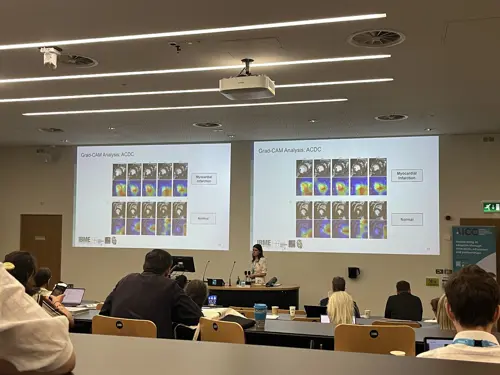
Olivia presenting her work
Olivia's paper is titled "Spatiotemporal Deep Learning for Myocardial Infarction Detection in Cardiac Cine MRI". It presents a deep learning approach for classifying myocardial infarction from routine cardiac cine MRI without the need for contrast-enhanced imaging. The paper compares several spatiotemporal architectures and demonstrates that modelling the full cardiac cycle using a ResNet-50-BiLSTM achieves robust performance and strong generalisation across independent datasets (ACDC and Sunnybrook). Olivia gave an oral presentation of her work in Oral Session 2: Cardiac Imaging AI on Monday 20th July, at 14:15, in the George Moore Auditorium.
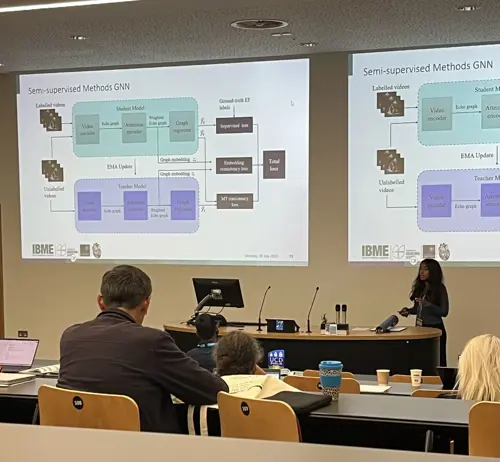
Annika presenting their work
Annika’s paper, titled “Semi-Supervised Graph Neural Networks for Ejection Fraction Prediction from Cardiac Ultrasound”, presents a semi-supervised geometric deep learning framework for predicting left ventricular ejection fraction from echocardiography. Using the EchoNet-Dynamic dataset, the paper investigates how graph neural networks can leverage both labelled and unlabelled cardiac ultrasound data through semi-supervised learning to improve prediction performance while reducing the reliance on costly clinical annotations. The results demonstrate the potential of graph-based semi-supervised learning for more data-efficient cardiac image analysis. Annika presented their work on Monday 20th July, at 14:45, in the George Moore Auditorium.
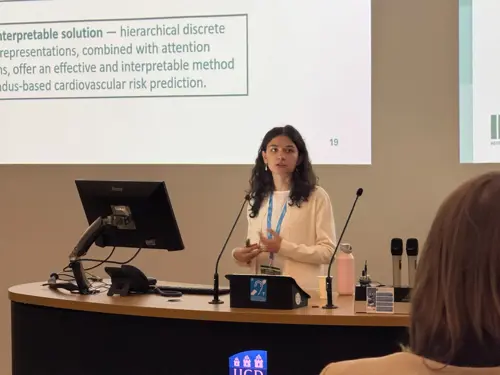
Aminah presenting their work
Aminah's paper, titled "Multi-Task VQ-VAE-2 for Cardiovascular Risk Prediction from Fundus Images", presents a multi-task deep learning framework that jointly reconstructs retinal fundus images and classifies cardiovascular risk. Fundus images provide a non-invasive, cost-effective means for predicting cardiovascular disease. The paper uses the China Fundus CIMT dataset and investigates how hierarchical discrete latent representations of the VQ-VAE-2, combined with a Dual Attention Network classifier module, capture both global and local retinal features while providing spatial attention maps indicating the regions that inform each prediction. The proposed model outperforms a Siamese SE-ResNeXt baseline, from the original dataset paper, achieving a macro F1-score of 0.7734, while preserving reconstruction quality. This demonstrates the potential of vector quantised representations for more interpretable cardiovascular risk assessment. Aminah presented their work on Tuesday 21st July, at 16:30, in the George Moore Auditorium.
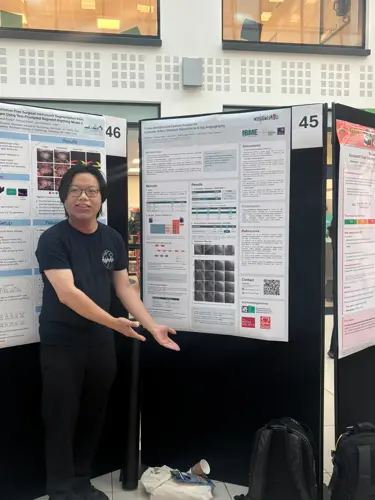
Haobo presenting a poster of his and Mojtaba's work | Haobo and Mojtaba’s paper is titled "Cross-Architectural Feature Fusion for Coronary Artery Stenosis Detection in X-ray Angiography". This paper explores how combining two very different kinds of neural network — a fast object detector and a network that has learned to segment coronary vessels — can improve the automated detection of stenosis (artery narrowing) in X-ray coronary angiography. More specifically, their approach, Fusion-YOLOv11-L, uses a small module they designed, called Channel Attention Gating, to let the detector draw on vessel-aware anatomical features. Their analysis suggests that this cross-architectural fusion improves not only in-domain performance but also generalisation to unseen patient data, where a lightweight test-time adjustment lifts performance further without any retraining. Haobo presented this work as a poster on 22nd July 2026. |
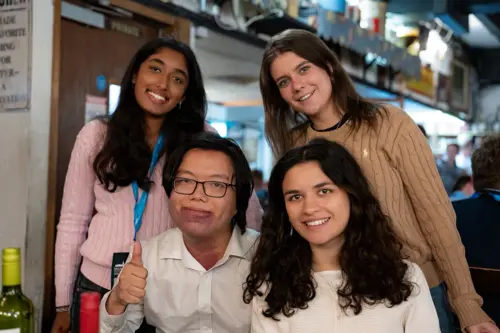
Members of the MultiMeDIA lab who presented at MIUA:
Annika (top left), Olivia (top right), Haobo (bottom left), and Aminah (bottom right).
We would like to congratulate all members of our lab who published work through MIUA this year, and who gave presentations on their work during the conference. We would like to especially highlight and commend the works of Olivia, Annika, and Aminah, who presented papers based on work done during their Master's theses which they wrote over the past year.


