Career Case Study - Oishi Deb, Department of Engineering Science, University of Oxford
DPhil Career Case Study

Oishi Deb
DPhil candidate, 'Thinking about Thinking' Research Fellow
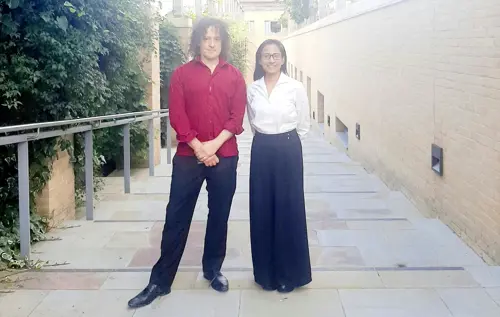
Oishi Deb is a DPhil candidate, 'Thinking about Thinking' Research Fellow in the Torr Vision Group (TVG) & Visual Geometry Group (VGG).
Artificial intelligence has enormous potential to transform biomedical discovery, from understanding diseases to developing new medicines. Oishi Deb, an ELLIS Oxford DPhil candidate in the Department of Engineering Science, is exploring how AI can help advance biomedical discovery while ensuring these powerful technologies are reliable, trustworthy and safe.
Oishi's research sits at the intersection of artificial intelligence, machine learning and bioscience. She develops AI methods that can support biomedical discovery, while also investigating how these systems should be rigorously evaluated before they are applied in safety-critical fields such as Human biology and Healthcare.
"My research focuses on AI for biomedical and biological discovery alongside AI safety through benchmarking and evaluation. I enjoy interdisciplinary research because it brings together different perspectives and complementary skills."
During her DPhil, she has contributed to projects ranging from Target Discovery, Brain organoid mitosis classification to evaluating large language models, with research published at leading AI conferences including NeurIPS and ICML.
The central question driving her work is simple but ambitious:
How can AI be used to accelerate biomedical discoveries while maintaining a strong focus on safety and rigorous evaluation?
Why it matters
As AI becomes increasingly integrated into scientific research especially biomedical discoveries, ensuring that these systems are safe is becoming just as important as making them more capable.
Oishi recently contributed to one of the largest systematic studies of AI benchmarks, working alongside 42 researchers from institutions including Stanford University, EPFL, UC Berkeley and the UK AI Security Institute. The team's paper, Measuring What Matters: Construct Validity in Large Language Model Benchmarks, was accepted to NeurIPS 2025 and calls for clearer definitions and stronger scientific standards when evaluating AI systems.
"The potential for AI in Science is enormous," says Oishi. "But these technologies need to be carefully evaluated so they can be used safely and responsibly."
The research attracted international media attention, including coverage by NBC News, The Guardian and other international outlets.
From industry to research
Before beginning her DPhil, Oishi worked at Rolls-Royce as a software and machine learning engineer. Although she enjoyed working in industry, it was during her fully funded MSc in Artificial Intelligence as a Google DeepMind Scholar that she realised she wanted to pursue research full time.
"Speaking with DeepMind scientists and DeepMind mentors made me realise that I wanted to do a PhD and contribute to advancing AI through research."
Her academic journey has included several notable achievements. During her undergraduate degree in Software and Electronics Engineering with Industry at the University of Leicester, she was named Student of the Year by the University's President and Vice-Chancellor. In 2019, she was also recognised as one of the UK's Top 100 influential people in technology by Business Insider.
One of the highlights of Oishi's DPhil has been appearing in the Brazilian television documentary Digital Minds: Era of Artificial Intelligence, broadcast on Fantástico, Brazil's largest weekly news programme, which reaches more than 20 million viewers and audiences in 118 countries.
The documentary explored the future of AI in healthcare and bioscience; and featured Oishi alongside her mentor, Professor Philip Torr, and Google DeepMind Vice President Pushmeet Kohli.
For Oishi, communicating research beyond academia is just as important as conducting it.
"I think it's really important to talk to the wider public and inspire young people to pursue research. Finding the right advisor isn't always easy, so when researchers share their work and experiences, it can encourage the next generation to see research as a career."
She has also recently become a Thinking About Thinking Fellow, providing opportunities to collaborate with researchers exploring the science of intelligence across disciplines.
Outside her research, Oishi enjoys tackling new challenges through hackathons. She recently helped secure third place at the Oxford AI for Good Hackathon for a project exploring AI for medicinal drug discovery.
When she's away from her computer, she enjoys practising yoga and playing badminton.
For Oishi, the biggest attraction of research is the opportunity to learn something new.
"There are so many unknowns. Navigating through those unknowns is both exciting and challenging and that's what makes research so rewarding."