14 Oct 2026
Oxford and Terumo launch six-year partnership to advance organ perfusion technologies
The collaboration will combine Oxford’s research expertise with Terumo’s medical technology capabilities to develop new applications for organ perfusion in transplantation and patient care

Global healthcare company Terumo Corporation will provide over $9m USD of financial support, access to proprietary technology and world-leading expertise in medical device development to support a major Oxford research programme exploring advances in transplantation and future patient-connected therapeutic technologies.
The University of Oxford and Terumo Corporation have established a six-year strategic research collaboration to advance organ perfusion technologies and explore new applications in transplantation and patient-connected therapies.
The Terumo-Oxford Collaborative Research Programme brings together researchers from Oxford’s Medical Sciences and Mathematical, Physical and Life Sciences Divisions with Terumo’s expertise in medical technology, engineering and global healthcare deployment.
The collaboration, which will be hosted at the IBME, builds on the scientific relationship that contributed to OrganOx, the IBME-developed Oxford University spin-out co-founded by transplant surgeon Prof Peter Friend and biomedical engineer and former Director of Oxford’s Institute of Biomedical Engineering, Prof Constantin Coussios, and acquired by Terumo in 2025.

The programme aims to expand the use of organ perfusion technologies beyond their established role in transplantation and explore how they might support new approaches to treatment development and delivery.
Professor Constantin Coussios, Pro-Vice-Chancellor for Innovation at the University of Oxford and Co-ordinating Director of the Terumo-Oxford programme, said: “OrganOx demonstrated what can happen when world-class research, engineering and clinical expertise come together around a major healthcare challenge.
This new collaboration allows us to build on that foundation and explore entirely new possibilities for organ perfusion technologies. Our ambition is to investigate how these technologies can support transplantation and future therapeutic applications, with the goal of improving outcomes for patients.”
Hikaru Samejima, Chief Executive Officer, Terumo said: “For more than a century, Terumo has pursued its mission of contributing to society through healthcare. This new partnership with the University of Oxford brings together world-class research and global healthcare expertise with a shared purpose: creating new value for patients. We are excited by the opportunities ahead and look forward to supporting research that can help shape the future of healthcare and improve patient lives around the world.”
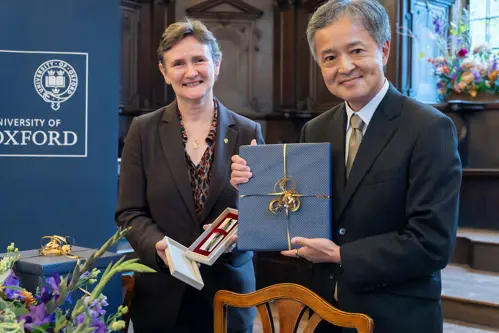
Professor Irene Tracey, Vice-Chancellor of the University of Oxford, said: “Oxford’s excellence in research is matched by our ambition to translate discovery into innovations that can change lives. OrganOx is a powerful example of that journey: born from pioneering Oxford research, developed through a successful University spinout, and now being scaled by Terumo to transform organ transplantation and patient outcomes around the world.
“Our partnership with Terumo builds on that success, bringing together Oxford’s world-leading research with Terumo’s deep industry expertise and global reach. By giving our researchers access to the knowledge and experience needed to translate new discoveries into practical applications, this collaboration will help create the next generation of life-changing technologies for transplantation and patient care. This is an exciting next chapter in Oxford’s relationship with Terumo, and I look forward to seeing the discoveries and innovations that this partnership will make possible.”
The programme will operate across Oxford’s Institute of Biomedical Engineering in the Department of Engineering Science and the Nuffield Department of Surgical Sciences, bringing together engineering and clinical expertise.


