07 Oct 2026
Exploring pathways to more resilient energy systems
Oxford Engineers contributed to the 2026 Oxford Energy Day, hosted by the Oxford Energy Network and the ZERO Institute on 17 September at the Mathematical Institute

Professor Paul Shearing (far left), Statutory Professor in Sustainable Energy Engineering, leading a panel at the Oxford Energy Day
Under the theme Towards resilient energy systems: research, policy and practice, the event brought together researchers, industry leaders, policymakers and civil society representatives to examine how resilience can be strengthened across energy systems. Discussions focused on the growing importance of resilience in the face of fossil fuel price volatility, rapid socio-technical change, and increasing dependence on electricity across critical infrastructure sectors.
Oxford Energy Day provides a unique forum for collaboration across disciplines and sectors. Networking opportunities remain one of the event's most valued features, enabling participants to share ideas, establish new partnerships, and develop innovative approaches to the challenges facing the energy transition.
The event was opened by Vice-Chancellor Professor Irene Tracey, who highlighted the University's longstanding contribution to energy research and innovation. She also paid tribute to Professor Malcolm McCulloch, a pioneering engineer, outstanding educator, and internationally recognised leader in sustainable energy systems. Professor McCulloch, who passed away earlier this year, played a transformative role in advancing the University's commitment to the energy transition and continues to inspire colleagues and students across the sector.
Throughout the day, speakers from academia, industry and government shared perspectives on the future of energy resilience, covering topics ranging from advances in individual technologies to whole-system modelling and socio-political analysis. Resilience was explored as the capacity of energy systems to anticipate, withstand, recover from and adapt to disruptions.
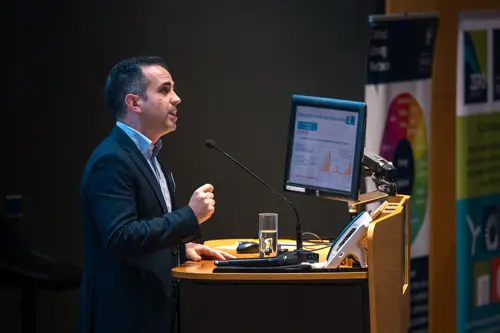
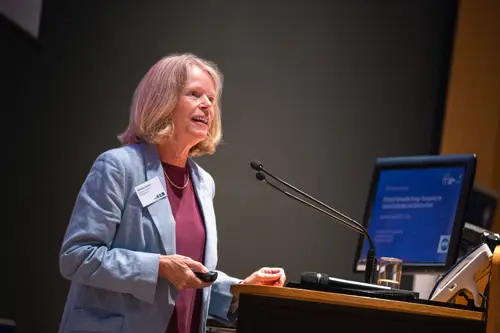
The programme featured keynote presentations, cutting-edge research talks, and a research poster competition for postgraduate students and early career researchers from Oxford and other universities. The posters showcased innovative research spanning energy technologies, advanced materials and systems, alongside policy, economic and social science perspectives. Keynote speakers included Deborah Greaves, Statutory Professor of Civil Engineering and Dr Jesus Lizana, who leads research on Zero-Carbon Heating and Cooling at the ZERO Institute.
"Achieving a resilient, net-zero energy future will depend on combining technological innovation with effective policy, governance and public engagement. Oxford Energy Day showcases the breadth of expertise across the University and beyond, while creating the connections that help translate research into real-world impact. It was inspiring to see such a strong commitment to collaboration across the energy community."
Professor Paul Shearing, Statutory Professor in Sustainable Energy Engineering and Director of the ZERO Institute
Key themes across the day included technologies that enhance resilience, such as battery storage, advanced materials and renewable energy generation; the economic foundations of resilient energy systems, including market design, innovation and business opportunities; and the links between resilience and energy security through electrification, demand reduction, diversification of energy sources and the evolving role of fossil fuels. The afternoon programme was divided into two parallel streams. The first focused on scientific and technical perspectives, covering resilience technologies, economics and energy security. The second explored social science dimensions, including organising for resilience and examining resilience through the lens of social equity and public value. Additional discussions considered how resilience can be supported through effective governance, data sharing and policymaking, while also examining broader societal questions around who benefits from resilience measures and how resilience can be delivered equitably.
The 14th Oxford Energy Day once again demonstrated the importance of collaboration, knowledge exchange and interdisciplinary thinking in addressing the complex challenges of building resilient, sustainable energy systems and delivering a successful global energy transition.