11 Mar 2026
Oxford-led cardiac AI research featured in Nature Machine Intelligence
The Institute of Biomedical Engineering is celebrating the publication of a major new study in Nature Machine Intelligence, selected as the cover article for the February issue.

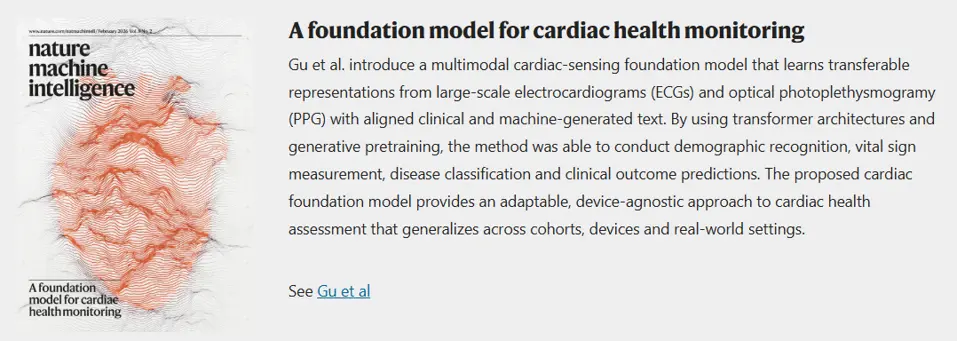
Illustration credit: Chaoyang Zhao
The paper, titled 'Cardiac health assessment across scenarios and devices using a multimodal foundation model pretrained on data from 1.7 million individuals', presents a transformative approach to cardiac monitoring and diagnostic modelling.
Published online on 24 February 2026, the work introduces a new Cardiac Sensing Foundation Model (CSFM) a multimodal, transformer-based foundation model trained on heterogeneous cardiac datasets from approximately 1.7 million individuals, integrating both physiological signals and clinical or machine-generated reports.
Cardiovascular disease remains a leading cause of death worldwide, yet detecting and managing heart conditions early is challenging. Doctors now collect heart signals both in hospitals (electrocardiograms or ECGs) and via consumer wearables (photoplethysmograms or PPGs from smartwatches). However, today’s AI tools struggle to generalise beyond the narrow conditions they were trained on – an algorithm trained on one hospital’s ECGs often fails on data from a different clinic or a home device. This “single-site bias” means patients outside the original setting (for example, those in resource-limited areas using simpler devices) don’t benefit equally, highlighting an urgent need for AI that works across diverse devices and environments.
Led by Dr Xiao Gu and Professor David A. Clifton, alongside an international team of collaborators, the study addresses this long-standing challenge in cardiovascular medicine: the variability of cardiac data across devices, settings, and signal types. Traditional models are typically trained on narrow datasets and struggle to generalise.
CSFM overcomes this by learning unified cardiac representations that can adapt across 12‑lead ECGs, single‑lead ECGs, PPGs, and mixed‑modality configurations – which are very typical yet challenging in diverse cardiac monitoring settings. In extensive evaluations, the model consistently outperforms the standard “one‑task‑one‑modality” approaches across diagnostic, demographic, vital‑sign and outcome‑prediction tasks.
CSFM is essentially a large-scale, general-purpose AI for heart health. In concept, this is akin to how large language models like GPT revolutionized text analysis, but here we are making a breakthrough at medical waveforms. The work signals an important step toward scalable, robust, and universally deployable cardiac monitoring systems, capable of supporting clinicians in diverse environments, from hospital units to remote or resource‑limited settings.
 A stylised cardiac core is surrounded by individuals, clinicians, and monitoring devices, reflecting how cardiac physiology is observed across clinical and everyday settings. The image represents a foundation model that unifies heterogeneous cardiac signals and contexts into shared representations for robust cardiac assessment. Credit: Chaoyang Zhao
The authors emphasise that this foundation‑model approach could support earlier diagnosis, improved risk stratification, and more equitable access to high‑quality cardiac assessment worldwide.
Professor Clifton reflected on the work of the team: “Heart disease is the leading cause of death, yet many patients with the condition lack access to consistent monitoring. Xiao has led the development of a new ‘foundation model’ for heart health – imagine a large language model like ChatGPT, but where the ‘language’ is healthcare sensor data. This model was built using data from 1.7 million patients, one of the world’s largest datasets of its kind. It then learns patterns between sensors, types of patients, and healthcare setting (e.g., hospital, home, etc.)".
"The result is extremely promising for helping doctors detect heart problems earlier – and more fairly, such as in our longstanding collaborations in low-income countries, including the Oxford University Clinical Research Units in Vietnam and Nepal. This breakthrough could bring reliable heart monitoring to more people, including those in remote or under-served places. I think it very well-deserved that this fantastic work led by Xiao has been given the accolade of the cover feature for the primary Nature journal in AI.”
Find out more about the work of the Computational Health Informatics Group.


