17 Dec 2025
DPhil Candidates in Sustainable Water Engineering win awards at Innovation Driven Water Sustainability Conference
Omar Daoud and Gayatri Sundar Rajan were announced as winner and finalist of the Global Prize for Innovation in Water 2025.

The Global Prize for Innovation in Water award winners celebrate
Omar Daoud was the winner of the Discovery Award for emerging technology in the ‘Circular Treatment and Zero Discharge Technologies’ award track of the Global Prize for Innovation in Water, for his entry ‘Green Cement’. The vision for the innovation behind his award is strategic: to engineer a scalable circular economy by integrating the production of the world’s 1st and 2nd most consumed resources: fresh water and building cement.
Gayatri Sundar Rajan was selected as a Finalist in the ‘Digital Economy’ award track. Her innovation enables water & cooling in a sustainable, capital-efficient, and off-grid package with a hardware & software integrated ecosystem.
Both DPhil candidates work in the Sustainable Water Engineering research group, under the supervision of Professor Nick Hankins in the chemical engineering panel. Omar is also closely advised by Dr Christian Peters, a DPhil from Oxford Engineering Science and CEO & co-founder of Seloxium, and Gayatri is co-supervised by Professor Binjian Nie.
Mr Daoud was one of 14 winners announced during the awards ceremony, which was held as part of the 4th edition of the Innovation Driven Water Sustainability Conference (IDWS 2025) which took place on the 8th December in Jeddah, Kingdom of Saudi Arabia.
The names of the winners were revealed by the sponsors, the Saudi Water Authority (SWA), after their proposed innovations passed strict evaluation criteria set the by the international judging panel. The awards are made in recognition of the winners’ efforts in transforming research ideas into technologies ready for real-world applications.
The awards followed a final qualification stage that featured 36 finalists selected from 2500+ entries from 119 countries, and representing leading universities, advanced research centres, and global technology countries. The winning innovations covered six key tracks vital to the water sector. The winning solutions stood out for their economic feasibility, positive environmental impact and strong potential to address global challenges related to water scarcity and climate change.
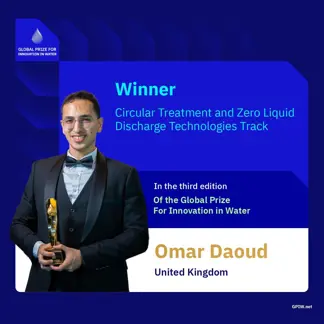
Reflecting on his achievement, Omar said: “It was a privilege to engage with peers both as a Finalist and as a Speaker. Sharing the field with such driven pioneers reinforces my confidence in our sector’s growth potential. My deepest gratitude goes to those who enabled this work, particularly my academic & project supervisors Professor Nick Hankins and Dr. Christian Peters for their support & guidance, and the Mohammed bin Rashid Al Maktoum Knowledge Foundation (MBRF) for their support and investing in knowledge that empowers global prosperity.”
Seawater is rich in salts and minerals. Omar’s research work aims to transform the salts retained by membrane-based desalination, via brine mining, into a green cement that avoids the carbon dioxide emissions associated with conventional Portland cement and indeed captures further carbon. By converting this brine into green building materials, the innovation behind ‘green cement’ turns an environmental challenge into valuable resources. It also cuts carbon emissions and provides the foundational inputs for global infrastructure, shifting the narrative from simple waste management to securing sovereign access to high value resource assets. As a result of producing fresh water more efficiently and turning sea-water minerals into eco-friendly building materials, this work tackles two global challenges at the same time; water scarcity and climate change.
 Talking after the ceremony, Gayatri said: "I am grateful and honoured to be recognized as a finalist in the 2025 Global Prize in Water in the 'Digital Business Model & Process Automation' category. My team and I proposed the “Apka Shakti (Your Energy) Ecosystem” to enable water & cooling in a sustainable, capital-efficient, and off-grid package. Our proposal for GPIW was two-fold: integrating water & cooling cogeneration hardware with a cloud software suite."
On the hardware side, Gayatri proposed the HYDECO - HYbrid DEsalination & COoling - system which can co-generate drinkable water & cooling from contaminated water & the sun. This process is a part of her DPhil thesis at the University of Oxford. On the software side, at Apka Shakti, Gayatri shared a suite of features to improve and extend the operation of water infrastructure, such as a HYDECO unit, over time: (1) Personalization with Machine Learning, (2) Maintenance & Operation Dashboard, (3) Cloud Data Storage & Analysis.
The applications of this ecosystem span waste heat recovery and reuse in data centres to providing scalable, off-grid drinkable water and cooling in high-need regions. By leveraging the synergies within the HYDECO technology and across the hardware-software elements of its development, Gayatri and co-workers hope to step into the future of digitalized energy infrastructure.

Omar Daoud reflects on his achievement

GIPW finalists on stage

Gayatri Sundar Rajan at IDWS


