29 Jun 2026
Department celebrates International Women in Engineering Day
On Tuesday 23 June the Department of Engineering Science celebrated the role of women in engineering and showcased some of the women engineers studying and working at Oxford

Despite soaring summer temperatures, the Department’s celebration of International Women in Engineering Day (INWED) this year attracted around 70 attendees to hear presentations from Department researchers and talks from external speakers. The afternoon’s activities brought together students, researchers, academics, and industry partners to celebrate the achievements and contributions of women in engineering. Researchers presented cutting-edge work, while representatives from Oracle, Infleqtion, Prysmian, and PwC shared insights into career opportunities across a broad range of engineering and technology disciplines.
Professor of Civil Engineering Deborah Greaves shared her career journey from civil engineering to specialising in fluid‑structure computational dynamics. She noted that women made up just 5% of the engineering workforce in the 1980s, compared with around 16% today, highlighting the progress that has been made while emphasising that there is still much work to do. Postgraduate students Maike Lenz (Adaptive Optics), Kayla Patel (Applied Digital Health) and Yiming Chen (Visual Geometry Group) presented highlights from their work.
The keynote speaker, Yasmin Ali, engineer and author, spoke about her career in the energy sector, from growing up in Baghdad where energy was scarce, to working in oil and gas and offshore rigs, and later transitioning into sustainable energy and improving domestic heat efficiency. She encouraged young female engineers to face challenges directly and pursue solutions rather than waiting for them to appear.
Department poster presentations included Institute of Biomedical Engineering DPhil student Thalia Seale, who presented her research in heart attack detection, focusing on how men and women present cardiovascular issues differently. She noted that more representative data is needed to validate this approach, particularly increased female anatomical data and further clinical trials
“It is great to bring women together to share different perspectives. Women are still underrepresented in engineering, and as someone at an early stage in my career, it is very inspiring to see the achievements of others in the field.”
Thalia Seale, DPhil student
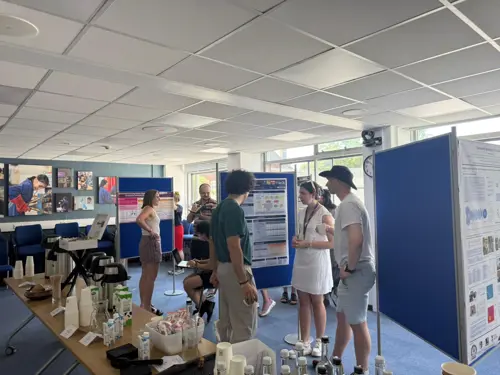
Emily Peacock, a DPhil Student in IBME’s Noble Group, discussed her work applying AI to predict baby weight in utero, which can help identify risk earlier and reduce complications associated with high and low birth weight. Emily reflected on the event, saying, “We need more events like this, as often as possible. Women’s issues are being talked about more than ever, but there is still much more work to be done.”
The afternoon concluded with a panel Q&A featuring Professor Tingting Zhu (IBME), Minal Patel, Programme Director in Digital Transformation at NHS England, and Samrina Bhatti, Consulting Director at PwC UK. The panel emphasised the importance of designing resilient systems, with Tingting highlighting the need to balance sensitivity and reliability in clinical decision support tools so that clinicians can trust and act on the outputs. Minal Patel stressed that strong data standards and involving both clinicians and patients in solution design are essential, while Samrina Bhatti noted that resilience in healthcare systems requires interdisciplinary collaboration.
 The panel concluded with careers advice for early career researchers and professionals, encouraging them to develop both breadth and depth of expertise, remain curious, and seek opportunities across both academia and industry. Samrina highlighted the importance of taking risks and building confidence, while Tingting reflected on the different strengths offered by academic and industry career paths.
“The panel was very inspiring. It was great to hear from industry professionals, and to recognise that imposter syndrome is real. It is encouraging to know that we are all working to make a difference.”
Indumita Prakash, DPhil Student
A space for female identifying engineers to gather, network and be inspired
Department students, researchers and academics celebrated INWED further with a dinner at St Peter’s College, hosted by Head of Department Professor Clive Siviour. Invited speaker Sallyanne Lewis, Structures Partner & Head of UK Culture at Buro Happold, talked about her entrance to STEM, her journey navigating the construction industry and the joy of seeing her designs come to life. She attributed her varied and successful career to taking opportunities and embracing uncertainty: “I never had a firm plan, or an end goal.. but looking back I navigated by a set of values. I had to be having fun, feel excited about my work and feel inspired to always do better”.
“Be curious. Take opportunities. Embrace uncertainty. Find great people to work with…. Because if there's one thing my career has taught me, it's that you don't need to know exactly where you'll end up”.
Sallyanne Lewis, Buro Happold

Her words of encouragement and advice to women entering engineering was to “Be curious. Take opportunities. Embrace uncertainty. Find great people to work with…. Because if there's one thing my career has taught me, it's that you don't need to know exactly where you'll end up”.
Sallyanne talked about the difficulties in attracting women to Engineering: “The decision to study Engineering as a woman still takes a brave leap – but that bravery puts you in a great position for the resilience required to be happy in this industry. Balancing my life between time spent working and time spent doing other things is crucial to me, and something I have never apologised for, whether that was bringing up my son, or finishing work on time to get to rowing training”, and emphasised how important good mentors and allies were for women progressing in the industry.
Vice President of the Department’s Women in Engineering Committee, Hanida Tomlinson, sums up the event. “Despite the warm weather, the event progressed well and received very positive feedback from both speakers and attendees. The dinner at St Peter’s was a wonderful way to round off the day, with great food and excellent conversation”.
With thanks to our students and researchers who spoke and presented posters on the day:
| Oral Presentations | |
| Kayla Patel | AI for Sepsis Detection in Low-Middle-Income Countries |
| Yiming Chen | PhysFormer: Learning to Simulate Motion in World Coordinates |
| Maike Lenz | Imaging Living Neurons through Multimode Optical Fibres |
| Research Posters | |
| Anda-Raluca Epure | Minibinder Lab: The Reliability Gap of Agents for Designing High Quality |
| Anna Taipale | Combined Crystal Plasticity and X-FEM Modelling of the Brittle to Ductile Transition of Single Crystal Tungsten Microcantilevers |
| Emily Peacock | Can we use AI to predict pregnancy outcomes |
| Indumita Prakash | Deriving Quantitative Cerebral Blood Flow Time-Courses from Multimodal Data Using the Simplified Davis Model |
| Mahsa Jalali | Nature-Inspired Plasmonic Nanostructured Microfluidics for Biosensing and Drug Monitoring |
| Shreya Banerjee | Sustainable Heatscape in Global South |
| Thalia Seale | Beyond EF: Characterising Heart Failure in Women Using Cardiac Motion Features |
With thanks to Phil Wood, Institute of Biomedical Engineering, and the Women in Engineering Committee for content and photos.

Professor Deborah Greaves

Yasmin Ali, keynote speaker

Posters and Industry stands


St Peter's College

The dining hall at St Peter's College


