20 Mar 2026
Institute of Biomedical Engineering hosts 2026 Open Day
On Wednesday 11th March IBME academics and researchers hosted 58 sixth-form students from around the UK for an introduction to Biomedical Engineering with examples from research projects in progress across the institute.

Researchers demonstrated tools used to monitor athletes for concussion
The day began with an introduction to biomedical engineering as a discipline from IBME Director, Professor Robin Cleveland. Prof. Cleveland outlined how the field brings together engineering, medicine, and the life sciences to solve some of the most complex challenges in modern healthcare. He outlined a range of major focus areas across IBME, including diagnostic engineering, therapeutic technologies, medical imaging, medical devices, implants, and prosthetics, biomaterials, pharmaceutical engineering and neural engineering.
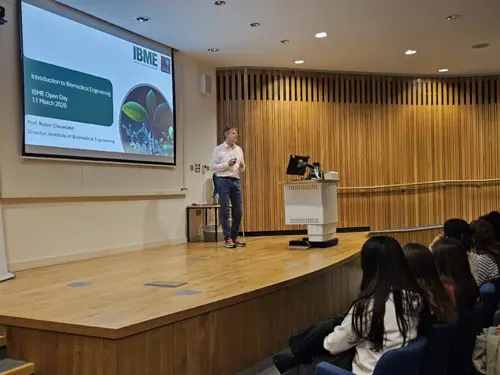
Throughout the day, between talks, students rotated through demonstrations delivered by current IBME researchers and students, each showcasing a different strand of biomedical innovation. Students were encouraged to ask questions and speak directly with researchers. Many wanted to know how to pursue a future in biomedical engineering, what subjects to study, which resources to explore, and how to stay informed about developments in the field.
The students also had the opportunity to hear from other IBME academics and researchers to learn about their respective fields and what drew them to pursue biomedical engineering at IBME.
Professor David Clifton introduced the students to AI in medicine by discussing how fictional portrayals of “killer AI” in films initially sparked his interest in the field. He contrasted cinematic sophistication with the limitations of current generative AI, which is prone to error and hallucination, problems that make accuracy essential in healthcare settings. He highlighted the potential for improved AI systems to transform medical care in low- and middle-income countries, where annual healthcare spending may be under $40 per person. Prof. Clifton encouraged students to pursue foundational subjects like mathematics, physics, computer science, before specialising in AI for healthcare, and his talk prompted many questions from the audience.
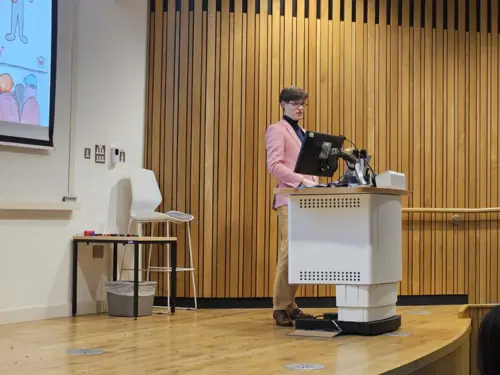
Professor Cathy Ye shared her journey from studying chemistry in Wuhan to applying that expertise to tissue engineering at Oxford. She described the long process of synthesising tissues, from early work on thin layers of cells to using bioreactors to create complex vascular structures. She invited students to consider future challenges in the field: Could we one day create fully synthetic organs? Can lab grown meat replace traditional production at scale? She encouraged students to think creatively about the engineering breakthroughs needed to achieve such goals.
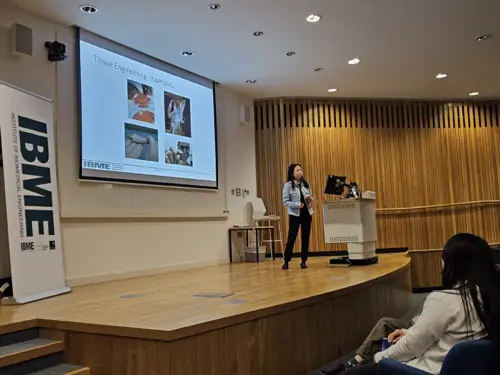
Dr Ryman Hashem from the Podium Institute of Sports Medicine and Technology introduced students to the challenges in modern robotics, focusing on AI, biohybridisation, and medical applications. He compared current wearable protection devices with future possibilities for improving safety in highspeed or impact heavy sports. His talk highlighted how materials science, physics, programming, and engineering intersect in soft robotics.
Finally, Professor Vicente Grau offered an insight into how a digital twin, which is a virtual model of a patient’s heart, can be constructed using MRI data to simulate cardiac function. These models can help predict future health issues and guide personalised treatment. Although still developing, this area holds significant potential and draws on expertise in imaging, modelling, computation, and physiology. The day was filled with curiosity, thoughtful questions, and enthusiasm. We hope to see many of these young visitors go on to study Biomedical Engineering in the years ahead as the next generation of scientists.


