19 Dec 2025
Scientists develop ultrasound-triggered implants to treat back pain
Researchers at the University of Oxford and Imperial College London have jointly developed a new approach to repairing damaged spinal discs, using ultrasound to remotely trigger the formation of implants inside damaged tissue.

Dr. Anna Constantinou, Department of Physiology, Anatomy and Genetics, in the lab
Lower back pain affects hundreds of millions worldwide and is a leading cause of disability. Much of this burden stems from degeneration of the intervertebral disc, which is the flexible, force-absorbing cushion between the bones of the spine. When these discs wear down with age or injury, bones rub together, causing pain. Current treatments, from pain medication and physiotherapy to spinal fusion surgery, often fail to restore long-term function or quality of life. Scientists are therefore exploring minimally invasive materials that can be injected as liquids and then solidify (‘gel’) inside the body, restoring cushioning to damaged discs. The challenge with these approaches is how to control where and when this solidification happens.
Now, researchers at Oxford’s Institute of Biomedical Engineering and Kavli Institute for Nanoscience Discovery and Imperial’s Sir Michael Uren Hub in White City, London, have demonstrated a proof-of-concept technology that could address that challenge and expand the range of treatment options available to patients. Their study, published in Advanced Healthcare Materials, introduces a liquid biomaterial that can be injected directly into a degenerated disc and then solidified, on demand and with great spatial control, using focused ultrasound.
Ultrasound as a clinical “switch”
Ultrasound – sound waves beyond human hearing – can be used not just for imaging, but also for therapy. Focused ultrasound can safely heat deep tissues, much like a magnifying glass focuses light to raise the temperature in a small spot (enough to start a fire). Combining this with an injectable liquid implant material that solidifies into a gel when warmed to a couple of degrees Celsius above body temperature (~41 °C), creates a local, minimally invasive treatment of damaged spinal discs.
The injectable implant material consists of 3 components – all common biomaterials already used in advanced medical therapies: 1) alginate (a naturally derived polymer), 2) glass microspheres to accelerate heating of the material, and 3) heat-sensitive calcium-filled lipid vesicles called liposomes, which release their calcium content when heated (to ~41 °C) with focused ultrasound.
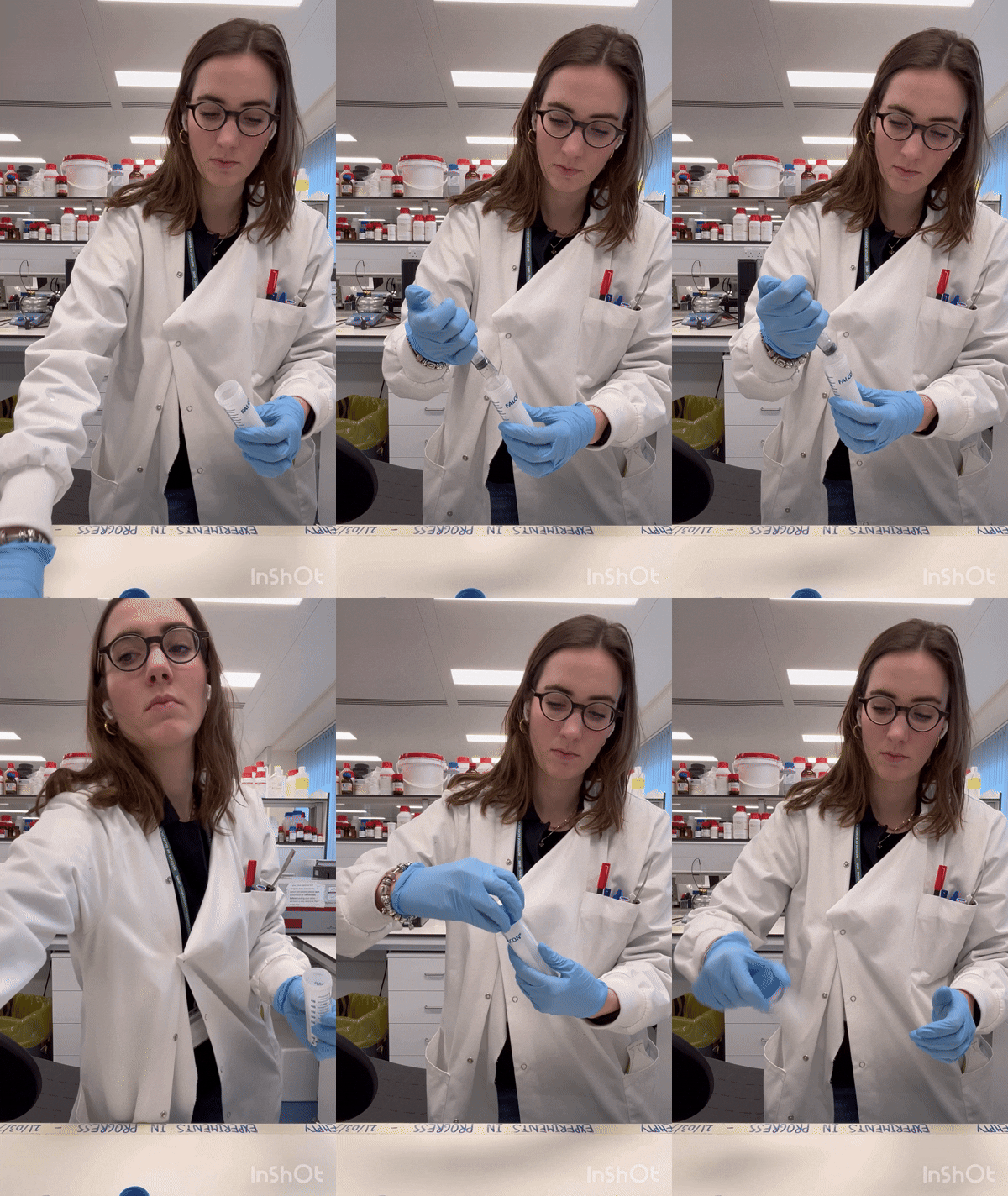
Dr Veerle Brans creates the injectable implant material, which consists of 3 components – all common biomaterials already used in advanced medical therapies
This released calcium causes the alginate molecules to form a network, turning the injectable liquid into a gel and thus forming a supportive solid implant precisely where and when the clinician requires. The only visible and invasive impact on the body would be an injection needle hole spanning one-third of a millimetre.
“Instead of relying on light-sensitive triggers that struggle to reach deep tissues or chemical reactions which give no temporal control, ultrasound gives us a safe, non-invasive way to control when and where an implant forms,” Dr. Anna Constantinou (Department of Physiology, Anatomy and Genetics), co-first author of the AHM publication. “This means clinicians can inject the material and then trigger its solidification at the most appropriate time, making the technology a versatile potential solution for addressing diverse clinical needs, including beyond back pain.”
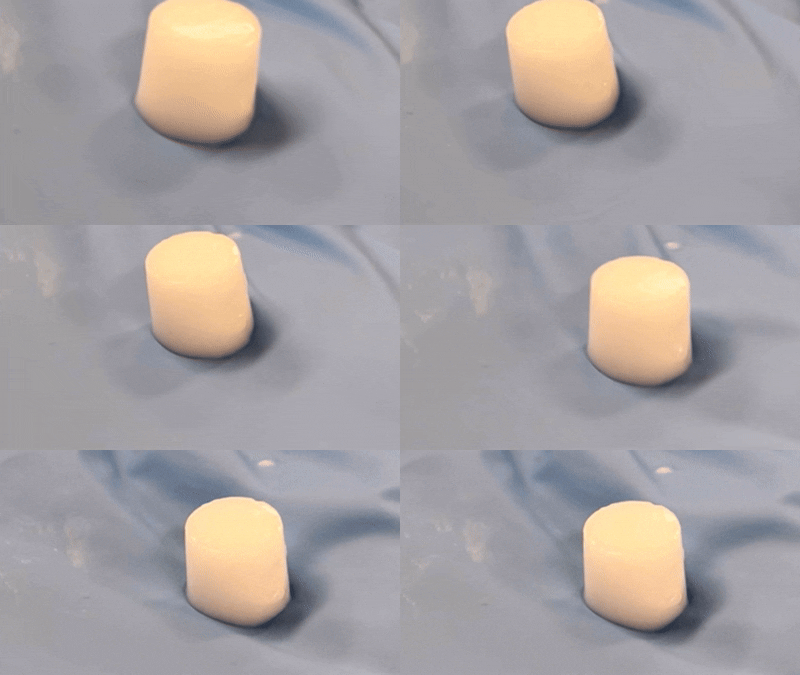
An injectable liquid implant material solidifies into a gel when warmed to a couple of degrees Celsius above body temperature
To test this, the team designed treatment algorithms that precisely control heating while also ‘listening’ to the behaviour of tiny bubbles inside the liquid. These bubbles form and move in response to the changing pressure of the ultrasound waves, a process known as cavitation. You can imagine it like opening a bottle of sparkling water: bubbles suddenly appear and grow as the pressure drops and then collapse. In the injectable material, this bubble activity generates sound that changes as the liquid turns into a gel: starting off loud, then fading as the material stiffens and the bubbles can no longer move freely. By tracking these sound changes, gelation and thus the treatment’s success is monitored in real time.
“By integrating real-time sensing into our ultrasound approach, we can do more than simply trigger solidification; we can also track it as it happens,” said Dr. Veerle Brans (Institute of Biomedical Engineering), co-first author of the AHM publication. “Our algorithms interpret the acoustic signature of the bubbles inside the material, giving clinicians the possibility of immediate feedback on how the implant is forming. This level of precision and monitoring means we are not just providing the treatment, we are controlling and verifying its success in real time.”
Promising early results
In laboratory experiments using dissected cow discs, the team at Imperial (Dr. Nic Newell and Dr. Matthew Kibble) showed that the implants integrated well with the disc tissue and partially restored biomechanical function and thus the disc’s natural cushioning ability. While further work is needed to confirm long-term biocompatibility and mechanical strength of the implants within humans, the components already have strong safety records in biomedical applications. The team envisions more sophisticated versions of the implant acting not only as structural support but also as a depot for anti-inflammatory compounds, regenerative growth factors, or even cells.
Towards translation
The use of focused ultrasound to release components from liposomes or cause gelation of liquid materials has already been trialled clinically for other applications, including liver tumour therapy and in vivo 3D printing. Patient-specific simulations and ex vivo human spine studies also suggest that ultrasound can be delivered safely through the spinal column, supporting the translational potential of this approach.
“This was an exciting collaboration, supported by the Focused Ultrasound Foundation (https://www.fusfoundation.org/), that could open the door to a new generation of minimally invasive orthopaedic therapies”, said Dr. Michael Gray, co-PI on the project.
Co-PI Professor Dame Molly Stevens added: “By combining innovative biomaterials with precise ultrasound treatment control, we aim to reduce recovery times, improve patient outcomes, and ultimately tackle one of the world’s most pressing health burdens.”
The power of sound: repairing spinal discs with ultrasound
Oxford Sparks video: Dr Veerle Brans explains how ultrasound could hold the key to treating back pain in the future.


